 |
Ambassador Richard Schifter
(left), with Austrian Ambassador
Dr. Hans Peter Manz at the
JHSGW annual meeting |
At the 52nd Jewish Historical Society of Greater Washington Annual Meeting, Sunday, December 2, 2012. Download this transcript as a printable PDF.
I suppose I have been around long enough to make it appropriate for me to offer remarks about my early years to a historical society. And I truly appreciate having been invited to speak to the
Jewish Historical Society of Greater Washington.
Childhood in Vienna
 |
Schifter as a baby
in Vienna |
As to the time period under discussion: I was born in 1923 and will review my early years as I grew up in Vienna, Austria, my experiencing the Nazi take-over of Austria, followed by my emigration to the United States, my new life in the United States, and then my service in the U.S. Army in World War II.
As I look back at my life in Vienna I need to distinguish between 14 ½ years of a rather pleasant existence and nine months of horror.
Vienna had for centuries been one of Europe’s most important cities. It had served as the capital of the Holy Roman Empire and then as the capital of the Austrian and Austro-Hungarian Empire. In the 19th century it evolved as one of the key centers of European culture in the field of the arts, literature, music, and the sciences.
There had been a Jewish community in Vienna for centuries. Like many other Jewish communities in Europe, it had suffered persecution since the time of the First Crusade, been driven out of Vienna at times, but after a while allowed to return.
A highly significant step forward occurred in 1782. Emperor Joseph II, the first Austrian monarch to be inspired by the principles of the Enlightenment, had issued a policy statement which became known as the
Edict of Tolerance. It significantly improved the life of Jewish residents of the Austrian Empire. One of the important steps forward was to allow Jews to study in public schools and at the university. Further progress was made during the 19th century as Jews began to integrate into the country and particularly and most significantly, into the cultural leadership of Vienna. Many Jews, including my father, gave great credit to the Emperor Francis Joseph, who had reigned from 1848 to 1916, thus for 68 years.
During my times in Vienna, Jews constituted about 10% of the city’s population. They were not uniformly distributed throughout the city. There were some neighborhoods that were overwhelmingly Jewish. Others, largely the areas in which industrial workers lived, had hardly any Jewish residents. The neighborhood in which I lived was about 25% Jewish.
 |
School Purim party in Austria. Schifter
top row, fourth from right. |
In that neighborhood I went to public schools that were open to all, played in parks that were open to all, joined the Boy Scouts, and thus participated in all activities in which other young people, irrespective of their religious or ethnic background, participated.
And yet, there was a problem in the background. I believe I was in Second Grade when one of my classmates told me, not hatefully, but in a matter-of-fact way, that I was responsible for the crucifixion of Christ. When I protested strongly that this was not so, his response was that that is what he had been taught in religion class. (Religion was a mandatory subject in all public schools in Austria.)
When I saw my parents that evening I cried bitterly as I told that story. Their response was to assure me that the allegation was not true, but it came with a warning that I can expect to hear that accusation again. This incident had such a traumatic impact on me that I still remember it distinctly, 82 years later, including the name of my fellow-student, what he looked like, and where we stood in gym class as he told me of my guilt. I am sure that you will not be surprised that I was, therefore, deeply moved by the Catholic Church’s rejection of that thesis with
Nostra Aetate in 1965 and the more vehement rejection by the Vatican with
We Remember in 1998. I noted with great interest that immediately after the issuance of
We Remember, Pope John Paul II went to Austria and delivered sermons there. I assume he discussed
We Remember.
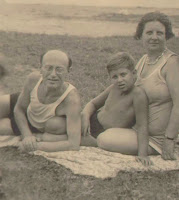 |
Schifter with his parents
in Austria |
I have made mention of my 2nd grade experience because it was highly relevant to the life of the Jewish community of Vienna. We benefited, on one hand, from the ideology of the Enlightenment that had most certainly taken hold in Vienna and caused many non-Jewish citizens to deal with Jews without hesitation, but at the same time we also were affected by the antisemitic doctrines that had been espoused for centuries and played a role in the political arena during my time.
As democracy evolved in Austria in the 19th century, two major political parties had become dominant in Vienna, the Christian Social Party and the Social Democratic Party. The Christian Social Party was a party of small shopkeepers and tradesmen. It was strongly supported by members of the Catholic clergy. The Social Democrats were the party of industrial workers, with support from a significant number of members of the intelligentsia.
The Christian Social Party was from the outset strongly antisemitic, partly for economic reasons: shopkeepers and tradesmen resented their Jewish competitors, and partly due to the religious teachings that the Jews were Christ-killers. In 1897 the Christian Social candidate for mayor, Karl Lueger, won the municipal election and for the next thirteen years governed the city, with a stream of virulent antisemitic statements emanating regularly from the mayor’s office. Among those who fully absorbed Lueger’s antisemitic views and made them his own was a young man who had come to Vienna from a small town in the countryside and was looking for a job. His name was Adolf Hitler.
Being told that I was a Christ-killer was only the first experience. While I was still in elementary school I had taken a great interest in geography and after asking questions on how one can put such knowledge to practical use I had come to the conclusion that I would want to be a diplomat. That notion was shot down when my father took me aside and said: “We are Jewish. And Jews can’t get jobs as diplomats.” My father’s statement came vividly to my mind close to fifty years later as I walked into the hall of the United Nations building in Geneva in which the UN Human Rights Commission met and took my seat behind the name plate that read “United States of America.”
But to get back to Austria in the early 1930’s: the Christian Social Party had established an authoritarian state in 1933. At the same time Hitler and the Nazi Party had taken control of Germany and there soon was increasing concern about a Nazi take-over of Austria. In 1934 the Austrian government succeeded in putting down a Social Democratic uprising in February and a Nazi uprising in July, but while the domestic Nazi problem had been put aside, there was the threat that Nazi Germany might move to take over Austria. Austrian Jews were well aware of the fact that the Nazi party’s outlook on Jews was significantly worse than that of the Christian Socials. In my time the Christian Social Party and its successor, the Fatherland Front, did not engage in antisemitic pronouncements, there was no segregation, and Jews could engage freely in private enterprise. Discrimination was limited to public employment. We all knew that under the Nazis it would be much worse.
Nevertheless it was understood that Jews in Austria did not have equal rights. That was the background against which my parents and I began to discuss my future. It was generally assumed that I should go to the University of Vienna and then emigrate. My father strongly recommended the United States, telling me that in the United States a Jew could even be a police captain. But I had become increasingly interested in Zionism, I planned to study agronomy and then use that training in what we then called Eretz Yisrael.
Nazi Takeover
 |
Schifter shortly before his
immigration to the United States, 1938 |
Then came March 11, 1938. When my father came home from work, he said he had heard that there would be an important radio announcement that evening. We turned on the radio and heard solemn music being played. After a while came the announcement that Chancellor Schuschnigg was going to speak. The Chancellor then informed the public that the German army was about to enter Austria, and that he was resigning. Following Schuschnigg’s talk we heard from the incoming Chancellor, Arthur Seyss-Inquart. (That was the beginning of a truly infamous career. Eight years later, at Nuremberg, Seyss-Inquart was convicted of war crimes and sentenced to death.)
It did not take my parents long to decide on our next steps. Before we went to bed that night they had decided that we would emigrate to the United States and that my father would immediately write to his uncle in New York to ask for an affidavit-of-support, which was required to obtain an immigrant visa.
That they had made the right decision became clear the next morning. Austria’s outgoing government had planned to hold a referendum on support of Austria’s continued independence. Slogans urging citizens to vote “yes” had been painted on sidewalks. On the morning of March 12 storm-trooper gangs had formed themselves and stopped Jewish-looking people in the street, gave them buckets and brushes and forced them to get down to scrub the slogans off the sidewalks. That practice went on for weeks.
I was then in what in the U.S. would be ninth grade, in secondary school. After the Nazi take-over, schools were closed for a week. When we returned to school, we faced a new arrangement. In my class there had been nine Jews. We all had had assigned seats. We were now told to sit in benches at the rear of the classroom, with an empty bench in front of us to emphasize the segregation. We quickly found out that every teacher who was Jewish, or was a convert from Judaism, or had a Jewish wife had been discharged. What we found particularly disappointing was that only one of our non-Jewish classmates would continue to talk to us.
Before long Jews were not allowed to enter the school through the main entrance. A side entrance was to be used by us and we had to use a special staircase set aside for Jewish students. At the end of that school year, Jews were completely excluded from all secondary schools in Vienna except for one school that was to serve the Jewish population.
My school experience was by far not the only consequence of the Nazi take-over for our family. My father owned a small drug store. Agents of the new government made the rounds to paint the word “Jew” on every Jewish-owned store and the public was urged to boycott these stores. The number of my father’s non-Jewish customers declined sharply.
We were, of course, at the same time focused on our emigration and soon discovered the meaning of the U.S. national-origins quota system. My parents, as natives of Poland, were put on a waiting list for their immigrant visas. I, as a native of Austria, could qualify for a visa. So, preparations were made for my departure. It was understood that my father would sell the store and my parents would migrate to Poland, to await the issuance of their U.S. visas.
Before I left there were two more particularly scary incidents. One evening in October 1938, when I was home alone, the doorbell to our apartment rang and, when I asked who was there, the answer was: “Police. Open up.” When I opened the door, a policeman stepped into the apartment and asked for my parents. When I explained that they were out for the evening, he told me to tell them, as soon as they came home, to report to a nearby police station. When they did arrive, I told them about the policeman’s instructions and they went off. I waited for them and as the hours passed and they did not return, I remember that my teeth began to chatter. My parents, who had been detained, as had been hundreds of other Jews in Vienna, were released the following day, after having been told to emigrate without delay.
Two weeks later came what has since become known as “crystal night,” the destruction of synagogues, the arrest of more than 30,000 Jews, who were sent to concentration camps, the killing of some of them, and the destruction of storefronts of Jewish businesses. It was the latter, the broken glass, that caused the coining of the term “crystal night.”
I was ill on that day and was in bed. My father, concerned that some of the goons would come to our apartment and take him away, hid all day under my bed. When the noise in the street died down, my mother ventured out and came back to report that the streets seemed safe now.
Not long thereafter my parents accompanied me to Vienna’s Western Railroad Station, where I boarded a train to Rotterdam. As the train left the station, we waved to each other. It was the last time that I saw my parents.
Coming to the United States
 |
Schifter's declaration of intent
to become a U.S. citizen, filed in
1941, three years after his arrival |
In Rotterdam I boarded a ship to the United States, where I was greeted by my U.S. relatives. I then lived with my grandmother’s brother and his wife in the Bronx. When I enrolled in high school, it turned out that my education in Vienna had indeed been of high quality. I was able to skip 10th grade and the first semester of 11th grade. After graduating from high school, I went to the College of the City of New York.
When the United States got into the war, I expected to serve in the Army and tried to complete my college education before then. By taking heavy course loads and going to summer school, I completed my college work in three years. When I attended my graduation exercises in 1943, I was already on initial leave from the Army.
I, of course, had greatly appreciated the fact that I had been able to escape to the United States. But there was more to it. I greatly appreciated living in a free country. After I had been in the United States for about six months I became aware of the fact that when dealing with other people I had stopped reflecting on whether or not they were Jewish. That had been an instinctual reaction that I had developed early in my life in Vienna.
High on my agenda during the initial years following my arrival was my effort to get my parents out of Europe, more specifically out of Poland, where they had fled. I recall writing to the State Department and to the First Lady, Eleanor Roosevelt, to ask for help. I tried to find a way of getting my parents to the Dominican Republic, whose President had opened the country up to receive refugees. I failed. My parents died in the Holocaust. When I entered the Army, l was fully aware of the fact that I would not see them again.
Ritchie Boys Service
 |
Schifter as a U.S. Army interrogator--a
member of the renowned Ritchie Boys |
After having graduated from college, I was off to Texas for infantry basic training. I believe that when my 13 weeks of basic training were up, I was in the best physical condition of my lifetime. My next assignment took me to Stanford University, where I was assigned, under the Army Specialized Training Program, to a group that was being trained for the occupation of what were then called the Dutch East Indies, now known as Indonesia. As I spoke both English and German, learning Dutch was quite easy. I was able to speak the language quite fluently after about six weeks of intensive training. We also studied the geography of East Asia and some relevant history. It was when we started to study Malay that I received orders that suddenly pulled me out of California and sent me across the continent to the Military Intelligence Training Center at Camp Ritchie, Maryland. It was made clear to me that preparing for the landing in Europe was now receiving priority.
The program at Camp Ritchie to which I was assigned trained us to be interrogators of prisoners of war. All of the trainees were fluent in German, with a large number of us having arrived as refugees from Nazi Germany. Our training program had two major features:
1. Providing us with information on the organization of the German army.
2.Teaching us how to ask questions in a fashion that was likely to elicit as much useful information as possible.
By July 1944, a few weeks after our landing in Normandy, I was off to Europe with a group of fellow Ritchie-graduates. We spent a few weeks at a camp in the English midlands. While there I was assigned to take a special training program in London on the German order-of-battle. That is where I experienced the bombing of the city by the first long-range missile, the V-1. The V-1 bombing had started one month earlier. It was designed to overcome Britain’s air defenses. I learned then that the V-1 was made in Peenemuende, in the Eastern part of Germany, an informational detail that I had occasion to remember a few months later.
In August a group of us was off to Omaha Beach in Normandy. By that time my colleagues and I had been assigned to IPW teams, teams of Interrogators of Prisoners of War. Each team had six members.
The front had moved on from Omaha Beach, but one could see the serious damage the war had left in the towns of the region. We were soon off to Paris via Versailles. I remember that a group of us spent one night sleeping on the floor of a ballroom in the famous palace. As we drove from Versailles to Paris there were large crowds along the road cheering us. In giving a speech in France some decades later, I observed that that may have been the last time Frenchmen applauded Americans.
We arrived in Paris two weeks after its liberation. It was bustling during the day, but the nights were strange. Paris was dark. The retreating German army had blown up the power station.
From Paris we traveled to Nancy, which was close to where the front was in the fall of 1944, then to Luxembourg, and from there to the area of Liege in Eastern Belgium. It was October 1944 and the U.S. Army was engaged in a battle in Eastern Belgium and the immediately adjacent area in Western Germany. As that battle came to an end, the U.S. army had occupied its first city in Germany, Aachen. Our IPW team was now attached to the First Infantry Division as it took control of the city.
What I do remember is that as we were approaching Aachen, I was reflecting on the fact that I was entering the country whose leaders had ordered my parents to be killed. How should that affect my dealings with Germans? I concluded that I must continue to adhere to the idea that guilt is individual, that I need to reject the notion of collective guilt.
The population of Aachen had been about 160,000. The great majority had fled during the fighting. There were about 20,000 left. Hitler had announced that an underground organization, called the
Werwolf, would be formed to fight against Allied occupation forces from behind the front lines. That led the Commanding General of the First Infantry to order the interrogation of all the remaining civilian population of Aachen. About ten of us went to work on that task, interrogating from early in the morning to late in the evening. If an interrogation had been satisfactorily concluded, we stamped the interrogated person’s identity card accordingly.
It was while performing that task that I believe I made a very useful contribution to the war effort. A middle-aged man had been assigned to me for interrogation. I had started with a customary question as to his occupation. His answer was “engineer.” My next question was: “Where do you work?” The answer was: “In Peenemuende.” I was by then well familiar with the work done in Peenemuende and aware that this could be an important interview. Abiding by what I had learned at Camp Ritchie, I continued by engaging the man in a friendly conversation. I asked him what it was that brought him from Peenemuende in Eastern Germany to Westernmost Germany. He explained that he had some leave coming and had relatives in West Germany and, therefore, had gone on vacation and visited his relatives. He then went on to say that as the Allied armies were coming closer and as he wanted the war to be over, he decided to await us in Aachen. The conclusion that I reached at that point was that he was running away from the Russians. It turns out that most of his colleagues followed him a few months later.
As we continued our friendly chat, I asked him about the result of our bombing of Peenemuende. His answer was to the effect that we hit some and miss some. It was at that point that, once again using my Ritchie training, I asked in a friendly fashion: “Could you sketch it out for me?” He thought for a while and then said: “I really want the war to be over. I’ll do it.” I handed him a notepad and a pencil and he provided me with a sketch of the German army facilities at Peenemuende. I expressed my thanks to him and took due note of his address in Aachen.
I immediately arranged a call to Air Force Intelligence in London with an explanation of our find. We were told to make sure that he does not get away, that two people from London would be in Aachen in twelve hours. When they arrived, we brought in our engineer from Peenemuende and the three of them went to another office to talk. After about two hours I got a call from one of the Air Force intelligence officers. I still remember what he said: “You hit a goldmine. We are taking him back to London.”
Another notable, but less important event of the work in Aachen was that two persons told us during their interrogation that they had been in the German army, had been captured by the U.S. Army, but had been released to work as American spies and were in Aachen on initial leave, before crossing over to the other side. We did not believe them and ordered them to be incarcerated. About a week later an OSS officer appeared in our headquarters and shouted: “What the hell are you doing to my agents?” It turned out they had told us the truth. They had been hired to serve as so-called line-crossers.
One of the truly scary periods of the stay in Aachen came in December 1944, with the Battle of the Bulge. The German offensive had started on December 16. German armored units had broken through south of where we were and we were at risk of being cut off. Given our role as interrogators, we assumed that in case of a break-through we would not make it out alive. Day after day the skies were cloudy, preventing our Air Force from going into action as German tank columns advanced westward. Then, on December 23, as daylight arrived, the sun was shining. I don’t think anyone of us ever greeted the sun as joyfully as we did on that day. And, sure enough, within a short while the sky was full of Allied planes. We were safe.
My unit stayed in Aachen until February 1945, when the final offensive in West Germany got underway. From then on, we were switched from one division to another as each would enter a major city. For each city we had a list of so-called “targets,” offices that we were to visit to look for documents of interest and concern to the United States. We started in early March in Cologne, went on to Coblenz, then to Frankfurt and from there to the Ruhr area.
One incident from that era that remained in my mind was our experience in Coblenz. We were to search a Secret Police office close to the Rhine River. The German Army was still on the other side and its artillery was still firing across the river. There were three of us who were assigned to the task of searching the Gestapo office, two Ritchie boys, and another soldier who had been an FBI agent. As we Ritchie boys started to crawl along the road that led to the Gestapo office, our FBI colleague said: “I am willing to die for my country, but not on this stupid mission.” So the two of us, Morrie Parloff, who in later years worked at NIH, and I, made it to the Gestapo office, searched the papers, and made it back.
By the end of April, as we approached the Ruhr area, German Army Group B was dissolving in front of us. German soldiers were putting down their arms and walking home. We had stopped taking prisoners. On April 30 Hitler committed suicide. I recall being in Duesseldorf the following day and hearing two German girls who were walking along the street, singing a song that was popular at the time, whose lyrics they had slightly altered. They sang. ”Everything comes to an end, everything passes, even Adolf Hitler and his Party.” It rhymes in German. [
Es geht alles vorueber. Es geht alles vorbei. Auch Adolf Hitler und seine Partei.]
In July 1945 I took my very first plane trip ever. My destination was Vienna, but U.S. planes had to land in the U.S. zone of occupation, so I traveled to Tulln, and made it to Vienna by car. I thus returned as a U.S. soldier to the city that I had left as a refugee. My visit had only one purpose: to bring canned food for one of my high school teachers, whom I had regarded highly.
 |
Schifter as a staff member of the
U.S. occupation government
of Germany |
My remaining months in the army were spent initially looking for documents of interest to us in Thuringia and Saxony, German states that were to be turned over to the Soviets, and then at the Military Intelligence Documents Center in Oberursel, near Frankfurt, reviewing the many German documents that had been collected and determining which were of interest. I also interviewed high-ranking officers detained at Oberursel.
I was discharged from the army in January 1946, but stayed on to serve as a civilian in the Finance Division of the Office of Military Government for Germany. That is another story.
Fighting for Soviet Jewry
Before I conclude, let me call attention to the Jewish Historical Society’s commemoration this week of the
25th anniversary of the Soviet Jewry rally on the Mall. I was Assistant Secretary of State for Human Rights at that time. I can most certainly confirm that the U.S. Soviet Jewry Movement played a key role in placing the Soviet Jewish emigration issue on the Congressional agenda in the 1970s and the Reagan Administration’s agenda in the 1980s.
What ultimately led to the wide opening of the doors of the Soviet Union to Jewish emigration was Secretary of State Shultz’s very informal but also very clear linkage of human rights with arms reduction. In April 1987, when the arms reduction discussions started, Shultz made a point of taking me along to Moscow and asking Soviet Foreign Minister Shevardnadze to name a counterpart for me, so that a human rights discussion could take place while arms reduction talks began. Shevardnadze agreed and my discussions with Soviet officialdom of human rights in general, but also, more specifically, the right to leave one’s country began.
With the second major arms reduction talk scheduled for September 1987, I decided to go to Moscow in August to see whether there was a chance for progress regarding human rights. The purpose was to provide updated information to Secretary Shultz before his meeting with Shevardnadze. One of the issues on my agenda was of course emigration. My contact at the foreign ministry, Anatoly Adamishin, suggested that I take up that issue at the OVIR, the office that issued emigration permits. I went to the OVIR The officials there where were prepared to talk to me about applicants for exit permits who had relatives in the United States, but not about any other cases, such as people who wanted to emigrate to Israel. They made it clear that they did not consider that to be the business of the United States. When I sought to hand over a list of
refusenik cases of concern to us, they refused to take it.
So I returned to the Foreign Ministry for a further discussion. I chose my words carefully. I called special attention to the OVIR’s refusal to take our list. I said I would have to report this incident to Secretary Shultz and that he would undoubtedly bring this issue up when he met with Shevardnadze a few weeks later, at the scheduled arms reduction talks. My expression of concern was noted.
On the following day I was at the Moscow airport, ready to move on to Warsaw, when a Foreign Ministry official who had been present at all my meetings, including the meeting at the OVIR, appeared on the scene. He arranged for me to sit in the VIP lounge, brought me a cup of tea, and then said: “That list that they did not want to take at the OVIR yesterday, please give it to me.” I handed the list to him.
When I got on the plane, I drafted a message to Secretary Shultz, in which I used Secretary of State Rusk’s phrase in the course of the Cuban Missile Crisis: “I think the other fellow has just blinked.” Sure enough, we got positive assurances at the September meeting and later that month and in October, the people on the list that I had handed over in August got their exit permits. One of them was the well-known Ida Nudel.
Then, in December 1987, Gorbachev came to Washington for a further discussion of arms control. After his meeting at the White House with President Reagan, I got a telephone call from the U.S. interpreter at that meeting. He told me that I would be interested in what had transpired when the meeting got started. After the initial formalities, Reagan had said: “There was a rally on the Mall last Sunday. There were hundreds of thousands of people there, all calling for people who want to emigrate from the Soviet Union to be allowed to do so.” Gorbachev said he had heard about the rally and wanted to go on to talk about arms reduction. But Reagan did not let him. He kept emphasizing the emigration issue. It took a number of minutes of further lectures on emigration before the meeting turned to arms reduction.
A few years later I had a meeting with Shevardnadze at which he made the following observations on how he and Gorbachev were able to bring others in the Soviet leadership around to support policy changes in the field of human rights. What he said was: “You spent 5% of your GDP on defense and were going to 7%. We were at 20% and could not go any higher. We needed an arms reduction agreement and could point out that changes in human rights policy could help us reach agreement.”
As you can see, that is how the Soviet Jewry movement reached its goal.

 Posts


